
Written by Sara Ibrahim, Cupindy Home Team · Last updated September 28, 2026
That neat stack of new bodysuits looks clean enough to use straight away, so do you really need to wash it first? Pediatricians say it's a good idea, and there's a real reason behind it, though it's not the emergency some articles make it sound. Below you'll find what the American Academy of Pediatrics (AAP), the NHS and US safety rules actually say, what one wash removes, when to start before your due date, and how to do that first load without fuss. The facts and figures come from published sources, listed at the end. It's general information, not medical advice, so if your baby gets a rash, your pediatrician is the right person to ask.
Short answer
- Yes, wash them first. The AAP calls it "generally a good idea to wash all clothes prior to using them". Coats that don't touch the skin are the exception.
- One wash does most of the work. In a 2022 study, garments washed once on a quick cold cycle had no detectable formaldehyde left.
- Start 2 to 4 weeks before your due date with newborn and 0 to 3 month sizes. Keep tags on bigger sizes so you can still exchange them.
- Use a fragrance-free liquid detergent (not pods), a normal or gentle cycle, an extra rinse, and low heat or a line to dry.
As an Amazon Associate we earn from qualifying purchases. This doesn't change which products we recommend.

Everyday detergent
all free clear liquid
No perfumes or dyes, Safer Choice certified per the listing, one jug for the whole family.
See it on Amazon
Made for babies
ATTITUDE Baby detergent
Unscented and EWG Verified, with 98% naturally derived ingredients, per the listing.
See it on Amazon
For baby stains
Dreft stain remover
Made for tough stains on baby clothes and bedding, plus a travel pen for the diaper bag.
See it on AmazonWhat happens if you don't wash baby clothes before wearing?
Most of the time, nothing. Plenty of babies wear a gifted outfit straight from the bag and are perfectly fine. Think of pre-washing as lowering a small risk, not avoiding a sure one. The babies most likely to react are those with sensitive skin or eczema.
What a first wash takes out is the stuff you can't see:
- Finishing chemicals. Some fabrics are treated with formaldehyde-based resins so they resist wrinkles and shrinking. Formaldehyde on fabric can cause allergic contact dermatitis in some people, according to a US Government Accountability Office report.
- Loose dye. New, bright fabrics can shed extra dye, which is why a first wash can tint the water or a white sock.
- Dust and handling. Between the factory, the warehouse, the store and your home, new clothes pass through a lot of hands and boxes. Hand-me-downs pick up dust in storage too.

Babies are more exposed than adults for two reasons. Their skin is thinner: a study in Pediatric Dermatology found infant skin up to 30% thinner than adult skin. And they wear their clothes day and night, sleep in them and, sooner or later, chew on them.
What the testing found
- 2022, Spain, 120 garments: formaldehyde was detected in 20% of new garments, at up to 55.7 mg/kg, and baby socks gave the highest estimated exposure. The researchers then washed 20 garments once, on a quick 30-minute cold cycle, and none showed detectable formaldehyde afterward. The levels they measured were below safety limits, and the authors call washing before first use "a safe and simple practice".
- 2010, US government, 180 textiles: most had low or undetectable formaldehyde, but 10 were above 75 ppm, mostly items sold as "wrinkle free", "no iron" or "easy care". One infant and toddler crib sheet measured 85.4 ppm. For comparison, Japan doesn't allow detectable formaldehyde (under 20 ppm) in products for children under 3.
- The caveat: the same US report says washing "often reduces formaldehyde levels but is not always successful", depending on the finish. One wash is a good habit, not a guarantee.
What the AAP, NHS and safety rules actually say
You'll see plenty of articles claiming pediatricians insist you must. The real guidance is calmer than that, and it differs a little between the US and the UK.
| Source | What it says |
|---|---|
| AAP, HealthyChildren.org, "Cleaning Baby Clothes" | "It's generally a good idea to wash all clothes prior to using them", except outerwear that doesn't touch the skin. Special baby detergents are often recommended, but most parents wash baby clothes with the family laundry without problems. |
| AAP, "Laundry Room and Detergent Safety" (2024) | If children 6 or younger live in or visit your home, consider regular detergent instead of single-load packets (pods). |
| NHS, "What you'll need for your baby" (reviewed 2024) | "There's no evidence that using washing powders with enzymes (bio powders) or fabric conditioners will irritate your baby's skin." The page doesn't say whether to pre-wash. |
| NHS hospital leaflet, Royal Devon, "Baby skincare" | "Wash all baby clothes and bedding prior to use and routinely in non-biological washing powder and rinse thoroughly." |
| CPSC, US children's sleepwear rule | Children's pajamas in sizes above 9 months, up to size 14, must be flame resistant or snug-fitting. Garments sized 9 months and under are exempt. Flame-resistant fabric is tested after 50 wash-and-dry cycles. |
So is pre-washing an NHS rule? Not on the national site. Some NHS hospitals recommend it in their own leaflets, and it lines up with the AAP's advice. Either way, one wash costs you little and removes most of what's on new fabric.
When to wash baby clothes before birth
Aim for 2 to 4 weeks before your due date. The Bump suggests "a couple of weeks to a month before delivery": close enough that clothes don't sit collecting dust, early enough that you're not folding bodysuits between contractions.
- Is 32 weeks too early? No. You can wash at 28, 30 or 32 weeks if you store the clothes clean, folded and in a closed drawer or bin. If they sit out for months, give them a quick rinse again.
- Have the first-week items ready by about 36 weeks. A baby born at 37 weeks or later is no longer considered premature, so plenty arrive before the due date.
- Wash in size order. Newborn and 0 to 3 month clothes first, including the outfit in your hospital bag. Larger sizes can wait until your baby is close to fitting them.
- Keep the tags on anything you might return. Once a gift is washed, many stores won't take it back.
As an Amazon Associate we earn from qualifying purchases.
Still building your registry?
An Amazon Baby Registry is free to create, and family and friends can buy from it and ship gifts straight to you. It also helps you keep track of how many bodysuits, swaddles and burp cloths you already have before you start washing.
Start an Amazon Baby RegistryWhat to pre-wash (and what can wait)
Wash anything fabric that will touch your baby's skin or go in the mouth. That list is longer than just clothes.
Wash before first use
- Bodysuits, sleepers and pajamas in newborn and 0 to 3 month sizes
- Swaddles and receiving blankets
- Burp cloths and bibs
- Crib, bassinet and changing pad sheets
- Socks, mittens, hats and headbands
- Hand-me-downs and anything bought secondhand
- Car seat cover and soft toys, only if the label or manual says they are washable
Can wait
- Clothes in 3 months and up: wash them when your baby is close to fitting them
- Gifts you may exchange: keep the tags on until you decide
- Coats and snowsuits that don't touch the skin, as the AAP notes
How many do you need for the first weeks? The NHS suggests about 6 vests (bodysuits) and 6 stretch suits (sleepers) for day and night. That's roughly one load, so your first pre-wash doesn't need to be huge.

If you're short on basics
Gerber 8-Pack Short-Sleeve Onesies Bodysuits
Eight plain bodysuits in 100% cotton rib knit, with lap shoulders so you can pull them down over the legs after a blowout, and snaps set high at the front for quicker diaper changes, according to the listing. It was one of the best-selling baby bodysuit packs on Amazon when we checked in September 2026.
Worth knowing: 100% cotton can shrink a little in a hot dryer, so dry them on low, as our guide to washing without shrinking explains. Sizes vary between brands, so check the size chart before you buy.
See the Gerber 8-pack on AmazonAs an Amazon Associate we earn from qualifying purchases.
How to wash baby clothes for the first time

- Remove tags, stickers and packaging. Cut off plastic tag fasteners and check for pins.
- Sort by color. Wash whites and pastels apart from dark or bright items for the first wash, since new dyes are the most likely to run.
- Prepare each item. Close snaps, zips and hook-and-loop tabs so they don't snag, and turn printed items inside out.
- Put small things in a mesh bag. Socks, mittens and headbands disappear in a washer. A small zip bag keeps them together.
- Use a fragrance-free liquid detergent at the dose on the label for the load size. More detergent is harder to rinse out.
- Choose the cycle the care label allows. Normal is fine for sturdy cotton basics; use gentle for knits, lace and older hand-me-downs.
- Add an extra rinse if your machine has one. An NHS hospital leaflet advises rinsing baby laundry thoroughly.
- Dry on low heat or on a line, and take things out as soon as they are dry.
- Fold and store in a closed drawer or bin so they stay clean until you need them. Our clothing storage ideas help if the nursery dresser is already full.

For socks and mittens
Muchfun 3-Pack Honeycomb Mesh Laundry Bags, 9 x 12 in
A small 9 by 12 inch size that suits baby socks, mittens and hats. The listing describes a heavy honeycomb mesh and a self-locking zip with a cover, designed so the bag stays closed through the wash and the dryer. It was one of the best-reviewed small mesh bags on Amazon when we checked in September 2026.
Worth knowing: the mesh is polyester, not cotton, and you get only three bags, so it's for small items rather than whole loads.
See the mesh bags on AmazonAs an Amazon Associate we earn from qualifying purchases.
First-wash settings at a glance
| Setting | For the first wash | Why |
|---|---|---|
| Water | Cold or warm, within the care label | Hot water isn't needed for new clothes and can shrink cotton |
| Cycle | Normal for cotton basics, gentle for delicates | Less wear on seams, prints and trims |
| Detergent | Fragrance-free liquid, label dose | No added scent or dye; liquid rinses out easily |
| Rinse | Add an extra rinse | Leaves less detergent in the fabric |
| Drying | Low heat or line dry | Limits shrinking and fading |
| Skip | Softener, dryer sheets, scent beads, bleach | None of them is needed on a first wash |
Do you need a special baby detergent?
Not usually. The AAP says special baby detergents are often recommended, but most parents wash baby clothes in regular family laundry without problems, and you only need to change detergent if your baby's skin reacts. What matters more is the formula: choose one without perfume or dye. WebMD adds that liquid detergents rinse out more thoroughly than powders, and that if your baby has eczema you can test a new detergent on one or two items first.
Skip the pods while your children are small
The AAP advises families with children 6 or younger to consider regular liquid or powder detergent instead of single-load packets. Poison centers received 1,423 reports of young children exposed to laundry packets in January and February 2024 alone. If a child does get into one, call Poison Help at 1-800-222-1222.
If you want a fresh bottle for the baby laundry, these are the three liquids we'd choose. All three are free of perfumes and dyes.
all free clear Original
Best forOne gentle detergent for the whole family
What the listing saysNo perfumes or dyes; Safer Choice certified
Worth knowingNot made just for babies, and the listing suggests pairing it with dryer sheets, which you can skip
See all free clear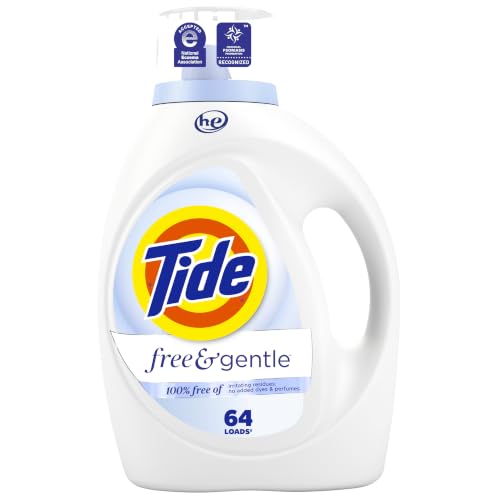
Tide Free & Gentle
Best forStain-prone loads washed in cold water
What the listing saysMade without dyes and perfumes; works in cold cycles
Worth knowingFewer loads per jug than all free clear, going by the two listings
See Tide Free & GentleATTITUDE Baby, unscented
Best forParents who want a baby-specific, mostly natural formula
What the listing saysEWG Verified; dermatologist tested; 98% naturally derived ingredients
Worth knowingCosts more per load than the other two at the prices we saw in September 2026
See ATTITUDE BabyClaims come from each product's Amazon listing, checked September 28, 2026. Our picks are our own; none of the sources on this page reviewed or endorsed them. As an Amazon Associate we earn from qualifying purchases.
Wondering what "free & clear" actually promises on a label? Our non-toxic laundry detergent guide breaks it down, with more brands compared.
Can you wash baby clothes with the rest of the family's laundry?
Yes, once you're using a fragrance-free detergent for everyone. Both the AAP and WebMD say most baby clothes can go in with the family wash. The exceptions: cloth diapers, which WebMD says should be washed on their own, heavily soiled items, and anything that snags, like towels and hook-and-loop fasteners, which The Bump suggests keeping away from delicate baby clothes.
Fabric softener, dryer sheets and baby pajamas
You don't need fabric softener or dryer sheets for baby clothes. The Bump and WebMD both suggest leaving them out. The NHS takes a softer line: it says there is no evidence that fabric conditioners irritate babies' skin. So if you already use a fragrance-free softener, you don't have to stop, but it adds nothing to a first wash. Softener can also leave towels and burp cloths less absorbent, which is the opposite of what you want from them.
Pajamas have one extra rule. In the US, children's sleepwear in sizes above 9 months, up to size 14, has to be either flame resistant or snug-fitting. Snug-fitting pajamas carry a label that reads "Wear Snug-fitting, Not Flame Resistant". Flame-resistant fabric is tested after 50 washes, so normal washing won't remove it. The AAP warns that soap flakes can, so keep them away from pajamas. Garments sized 9 months and under are exempt from these rules.
How to get spit-up, formula and poop stains out
These stains set as they dry, so speed matters more than the product.
- Rinse from the back with cold water as soon as you can, to push the stain out the way it came in.
- Pre-treat. Spray small stains with a stain remover. For a big blowout, soak the item in water with a little detergent, as Dreft suggests.
- Wash as usual and check the stain before drying. Dryer heat sets whatever is left, so treat and wash again if you still see it.
Our stain remover pick
Dreft Baby Stain Remover Spray, 2-Pack plus Stain Pen
Two spray bottles for tough stains on babies' and children's clothes, bedding and blankets, and a pen for spills when you're out, according to the listing, which also calls it hypoallergenic. It was one of the best-reviewed baby stain removers on Amazon when we checked in September 2026.
Worth knowing: two large bottles is more than most new parents need at first, so it suits you best if you expect a lot of laundry or want to share one. Always spot-test on a hidden seam first, especially on bright colors and prints.
See the Dreft stain remover on AmazonAs an Amazon Associate we earn from qualifying purchases.
Rash or hives from new clothes: what to do
A reaction to fabric or detergent is a type of contact dermatitis. Children's Hospital of Philadelphia describes it as redness, swelling, itching, scaling and sometimes blisters, usually worst where the skin touched the item. Most cases come from irritants such as soaps and detergents rather than true allergies. With clothes, look along the neckline, cuffs, waistband and wherever a tag or seam rubs.
- Take the item off and dress your baby in something that has been washed several times before.
- Rewash the new item with a fragrance-free detergent and an extra rinse before trying it again.
- Switch one thing at a time. If the rash comes back with every load, the detergent may be the cause rather than the clothes.
- Call your pediatrician if the rash spreads, blisters or oozes, doesn't start to improve within a few days, or comes with a fever or a baby who seems unwell. The AAP says to contact your doctor right away if a baby younger than 3 months (12 weeks) has a temperature of 100.4°F (38.0°C) or higher.
When can you stop pre-washing new clothes?
There is no official age. The AAP's advice to wash clothes before using them isn't limited to newborns, and the reasons (finishes, loose dye, handling) apply at any age. Many families keep washing new clothes before the first wear for good. What does change is how careful you need to be: once your baby has had months of clothes with no skin trouble, you can relax on outerwear, and you can move the whole family to one fragrance-free detergent. If your child has eczema or sensitive skin, keep pre-washing anything that touches the skin.
And washing baby clothes separately? Most families never need to, as long as the shared detergent has no perfume or dye.
Your first-wash checklist
- 2 to 4 weeks before your due date, wash newborn and 0 to 3 month sizes, swaddles, burp cloths and sheets
- Tags off, snaps closed, small items in a mesh bag
- Fragrance-free liquid detergent, no pods, extra rinse
- Low heat or line dry, then store in a closed drawer
- Keep a stain remover by the changing table for the first blowout
Missing something? As an Amazon Associate we earn from qualifying purchases.
Detergent: all free clear Baby detergent: ATTITUDE Mesh bags for socks Stain remover: DreftFrequently asked questions
Do you have to wash baby clothes from Amazon or hand-me-downs?
Yes, the same advice applies wherever they come from. Clothes shipped from a warehouse carry the same finishes as clothes from a store, and hand-me-downs collect dust in storage.
How many times should you wash new baby clothes before use?
Once is enough for most clothes. In a 2022 study, garments washed once on a quick cold cycle had no detectable formaldehyde left. Wash again only if an item still smells strongly of chemicals or your baby reacts to it.
Should baby clothes be washed in hot or cold water?
Cold or warm, within the care label. Hot water isn't needed for new clothes and makes cotton more likely to shrink.
Should baby clothes be washed on delicate or normal?
Normal is fine for sturdy cotton bodysuits and sleepers if the label allows it. Use gentle for knits, lace, embellished outfits and older hand-me-downs.
Can I wash my baby's clothes with my own?
Yes, if everyone's laundry uses a fragrance-free, dye-free detergent. Wash cloth diapers and heavily soiled items on their own.
Is 32 weeks too early to wash baby clothes?
No. Store the washed clothes clean and covered and they will be fine until the birth. Many parents aim for 2 to 4 weeks before the due date, with first-week items ready by about 36 weeks.
Do I need to iron baby clothes?
No. Take clothes out of the dryer while they are still warm, shake them and fold them, and most wrinkles fall out. For an outfit you want crisp for photos, see how to get wrinkles out without an iron.
Can new clothes cause a rash on a baby?
They can. Finishes, dyes and detergent residue can all irritate sensitive skin, which is the main reason to pre-wash. Remove the item, rewash it, and call your pediatrician if the rash spreads, blisters or comes with a fever.
Related guides
Sources
- American Academy of Pediatrics, HealthyChildren.org, "Cleaning Baby Clothes" (Laura A. Jana, MD, FAAP and Jennifer Shu, MD, FAAP).
- American Academy of Pediatrics, HealthyChildren.org, "Laundry Room and Detergent Safety" (updated April 2024).
- American Academy of Pediatrics, HealthyChildren.org, "Fever: When to Call the Pediatrician".
- NHS, "What you'll need for your baby" (reviewed May 2024).
- Royal Devon University Healthcare NHS Foundation Trust, "Baby skincare" leaflet.
- Herrero M. et al., "Early-Life Exposure to Formaldehyde through Clothing", Toxics, 2022.
- US Government Accountability Office, "Formaldehyde in Textiles", GAO-10-875, 2010.
- Stamatas G.N. et al., "Infant Skin Microstructure Assessed In Vivo Differs from Adult Skin", Pediatric Dermatology, 2010.
- US Consumer Product Safety Commission, Standard for the Flammability of Children's Sleepwear, 16 CFR Part 1615.
- Children's Hospital of Philadelphia, "Contact Dermatitis".
- American College of Obstetricians and Gynecologists, "Definition of Term Pregnancy".
- WebMD, "Baby Laundry Tips" (reviewed May 2025); The Bump, "How to Wash Baby Clothes"; Dreft, "How to Wash Baby Clothes".
- Amazon listings for all free clear, Tide Free & Gentle, ATTITUDE Baby, Dreft Stain Remover, Muchfun mesh bags and Gerber bodysuits (checked September 28, 2026).


