
You can spend an hour comparing BPA-free water bottles and still buy the wrong one, because the label almost everybody shops by is not regulated in the United States. So this guide starts somewhere more useful: what the bottle is physically made of, where the lead everyone read about in 2024 actually sits, and which six bottles are worth your money.
Came here for glass versus stainless steel? Short answer: both are fine. Glass tastes most neutral and lets you see that the inside is clean. Steel survives being dropped and can be insulated. Neither contains BPA, so the material argument is about your routine, not your health.
If that settles it, jump to the six bottles we would buy. If you want the long comparison, we keep separate guides to steel against plastic, insulated against non-insulated, and bottles for coffee.
The short version
- “BPA-free” is not a regulated claim in the US. The EU banned BPA in food-contact materials in January 2025. The FDA has not. Here the phrase is a manufacturer’s choice, and it is often met by swapping in a related bisphenol. The detail.
- The lead question has a two-step answer. That lead sits in a pellet sealing a vacuum chamber. Single-wall bottles have no vacuum chamber, so there is nothing of the kind inside them. Want insulation? Then buy from a maker that publishes what it seals with, because not all of them use lead. How this works.
- The simplest bottle made is unlined 18/8 steel with a screw cap and nothing else: the Klean Kanteen Classic. It will not keep water cold. That is the whole catch.
- Want cold water at 4pm? You need vacuum insulation, and the Takeya Actives is the one we would buy.
- Check your cup holder before you check anything else. More returns come from a bottle that will not fit the car than from any safety worry.
See the six picks Answer the lead question first
The picks at a glance
What’s on this page
Which problem are you solving?
Nearly everyone shopping for BPA-free water bottles turns up with one of four problems. Find yours and skip the rest.
“I read about lead in insulated bottles.”
Single wall removes the part completely. If you want insulation, choose a brand that publishes what it seals with. Read the mechanism
“I want to get away from plastic.”
Buy steel or glass, not a plastic bottle with a better label on it. Why the label is weak
“My water is warm by lunchtime.”
Only vacuum insulation fixes this. Nothing else is close. See the insulated picks
“Water tastes of metal in my bottle.”
Usually the lid gasket and a damp cap, not the steel. Glass ends the argument. The two-minute fix
What “BPA-free” means on a US label
Two jurisdictions, two completely different situations, and the label looks identical in both.
BPA in food-contact plastics
Coatings, varnishes, inks, adhesives
Other bisphenols, such as BPS
So what does a “BPA-free” label prove?
The FDA has not been idle. It withdrew its authorisation for BPA in baby bottles, sippy cups and infant formula packaging, while saying plainly that this followed industry abandoning those uses and was not a change in its safety view. Its published position is still that BPA is safe at the levels found in food today. A petition asking the agency to look again has been sitting since 2022, well past the 180-day window the rules set for a substantive answer.
Then there is the substitution problem. “BPA-free” often means swapped, not removed, and the usual swap is BPS. Look at what the EU did about that: its 2024 regulation does not stop at BPA but reaches other bisphenols carrying a harmonised hazard classification. A US bottle stamped BPA-free can still contain a close relative that has not been through the same decade of public argument.
Which is why every pick below is steel or glass. BPA-free plastic water bottles are not automatically dangerous, and for a child’s backpack a light plastic bottle is often the sensible call. But if bisphenols are what you are avoiding, buy a material that never had one in it. That is a shorter route than trusting a claim nobody audits.
Three claims that mean nothing on their own
- “BPA-free.” Unregulated here, and often satisfied by substitution.
- “Food-grade stainless steel.” Meaningless without the number. You want 18/8 or 304. If the listing will not say which, you have your answer. Our guide to stainless steel grades explains what the figures mean.
- “Non-toxic.” Not a defined term anywhere. It tells you the copywriter felt confident.
The lead question, answered properly
Since the story broke in January 2024, this is what people actually want to know. Most roundups either skip it or reassure you without explaining anything, so here is the mechanism, the company’s own words, what a court made of it, and the part that helps you choose.
What the manufacturer said
Pacific Market International, which makes Stanley drinkware, stated that its “manufacturing process currently employs the use of an industry standard pellet to seal the vacuum insulation at the base of our products; the sealing material includes some lead.” It added that “once sealed, this area is covered with a durable stainless steel layer, making it inaccessible to consumers,” and that “no lead is present on the surface of any Stanley product that comes into contact with the consumer nor the contents of the product.”
What a court made of it
Consumers sued, arguing the lead should have been disclosed at the point of sale. The case was dismissed in January 2025, refiled, and dismissed again on 3 April 2026 in the US District Court for the Western District of Washington. Judge Tana Lin found no plausible route by which the sealed pellet reaches a drinker in normal use. That second dismissal was without prejudice, so the file is not formally closed, but no court has found a path of exposure.
The part that helps you choose
That pellet is there to seal a vacuum chamber. Building a double-wall bottle means drawing the air out from between its two steel walls through a small port in the base, then closing that port permanently. A pellet or a solder is how it gets closed. Single-wall bottles have no chamber, no port and nothing to seal, so for them the question simply cannot arise.
The second half is where the “everybody does it” line falls apart. Lead is not the only way to close that port. Klean Kanteen says publicly that it uses lead-free solder across its insulated range, and silica or glass plugs to make the vacuum, noting the lead-free solder costs it several times more. The Environmental Working Group’s Olga Naidenko has said the same about the category: “We know the use of lead is avoidable based on online statements from manufacturers who find alternatives to lead for vacuum sealing their products.” So “industry standard” describes one common method. It does not describe the only one.
Single-wall bottle
- No vacuum chamber
- No port, so nothing to seal
- The lead question cannot arise
- Will not keep water cold
- Sweats on a hot day
Double-wall vacuum bottle
- Vacuum chamber between the walls
- A port in the base, sealed for life
- Sealed with a pellet, solder or plug, lead-containing or not
- Keeps water cold all day
- Stays dry on the outside
The rule this gives you: if lead is why you are shopping, single wall settles it by construction and costs you cold water. Want the insulation anyway? The question is still answerable, just brand by brand, from what that brand publishes. For each bottle below we say what we could and could not find.
The safest water bottle to drink from
People search this phrase a lot, so here is a direct answer rather than a hedge.
The safest water bottle to drink from is unlined 18/8 stainless steel or plain glass, with a lid you are willing to take apart and wash. Both materials are inert against water. Neither carries an interior coating that can wear through, neither needs a plastic liner, and neither ever contained a bisphenol. That is the whole answer, and it costs less than most people expect.
Two honest footnotes. First, phrases like “healthy water bottles” and chemical free water bottles are marketing, not categories. Everything is a chemical, including water, and no agency certifies either phrase. Second, the risk people worry about least is the one we would actually watch: a lid that never gets cleaned. A bottle in good condition, washed properly, is not a health problem in any material on this page.
The best water bottle material, ranked
Buy without hesitating
- Unlined 18/8 (304) stainless, single wall. One piece of steel. No liner, no interior coating, no chamber. It is the only construction that removes the sealing question instead of answering it. Check the Klean Kanteen Classic on Amazon.
- Glass with a silicone sleeve. The only material that cannot add a taste, and the only one where you can see whether the inside is clean. Heavier, and still breakable. Check the Lifefactory on Amazon.
Good, with one caveat
- Double-wall vacuum insulated stainless. Right for temperature, and the one category where you should check the brand’s published position on sealing before you buy. After that, choose on lid design and how easy it is to clean. Takeya Actives, CamelBak Chute Mag, Hydro Flask, Stanley IceFlow.
- Tritan and other hard plastics, for children. Light, cheap, survives a school year. Treat the label as the maker’s choice and keep hot liquid out of it.
We would not buy these for this job
- Steel bottles that will not state a grade. “Food-grade stainless” with no number, on a listing with no manufacturer behind it. That is the one genuine red flag in this category.
- Painted or coated interiors. Anything applied to the inside is a surface that can wear, and you will never be told what it was.
- Any insulated bottle bought without checking the brand’s sealing statement, if lead is your reason for shopping. The information is out there for some brands. Spend the two minutes.
The best BPA-free water bottles we would buy
Six bottles, all steel or glass, all carrying thousands of ratings and not dozens. Ratings and availability checked September 2026, and each card names a drawback you will not find in most roundups.
Best overall, and the answer to the lead question
Klean Kanteen Classic, single-wall 18/8 stainless

Buy it if the lead story is what sent you shopping, or you just want the least complicated bottle on the market.
One piece of food-grade 18/8 steel, unlined, with a BPA-free polypropylene cap and a 1.75 inch mouth that takes ice and a brush without argument. Nothing coats the inside. Nothing lines it. There is no vacuum chamber, so there is nothing sealing one. It is usually the least expensive bottle on this page, and the same listing steps up through larger sizes and better caps if you want them. Most people land on the 27 oz.
On sealing: not applicable, since it is single wall. Worth knowing anyway, because it speaks to the brand: Klean Kanteen publishes a lead-free position for its insulated range too, naming lead-free solder and silica or glass plugs. It was the only brand here we found doing that.
The drawback: one wall is a thermal bridge and physics does not negotiate. Cold water warms quickly, the outside will sweat, and in winter the metal is cold in your hand. The basic loop cap unscrews rather than sips, which is fine at a desk and awkward in a car.
See the Klean Kanteen Classic on AmazonBest insulated bottle for the money
Takeya Actives 24 oz, insulated spout lid

Buy it if you want one bottle for the car, the desk and the gym, and cold water matters more to you than the sealed base.
Double-wall vacuum insulated 18/8 steel, a spout lid you drink from one-handed without unscrewing anything, and a body narrow enough for a car cup holder, which the wide insulated bottles usually are not. It sits below the Hydro Flask on price for cold retention most people could not separate blind.
On sealing: we searched for a published Takeya statement about how its vacuum port is closed and found none. That is not evidence either way. It means the question is open, and their support team is where you close it.
The drawback: the finish is powder-coated, not bare steel, so it is a coating with a working life on a bottle that will get knocked about. And the spout lid carries a removable silicone gasket. Removable means it comes out weekly for washing, every week, for as long as you own the bottle. That is what one-handed drinking costs you.
Check the Takeya Actives on AmazonBest for taste
Lifefactory 22 oz glass with silicone sleeve

Buy it if you have given up on steel because of the taste, and the bottle mostly lives on a desk or a kitchen counter.
Glass cannot impart a taste of its own, and you can see straight through it, which no steel bottle allows. That second point matters more than people expect: you know when it needs cleaning. Lifefactory wraps the glass in a silicone sleeve that survives drops bare glass would not, says its components are made in the US or Europe, and rates the bottle dishwasher safe with the sleeve left on. It is the second-least expensive pick here.
The drawback: the sleeve grips the glass tightly, which is exactly what makes it protective and also means any water that creeps underneath has nowhere to go. Pull it off to dry every few weeks. And protection is not immunity. Glass on a hard floor is still glass, so this is not your gym bottle.
See the Lifefactory on AmazonBest lid design
CamelBak Chute Mag, vacuum insulated stainless
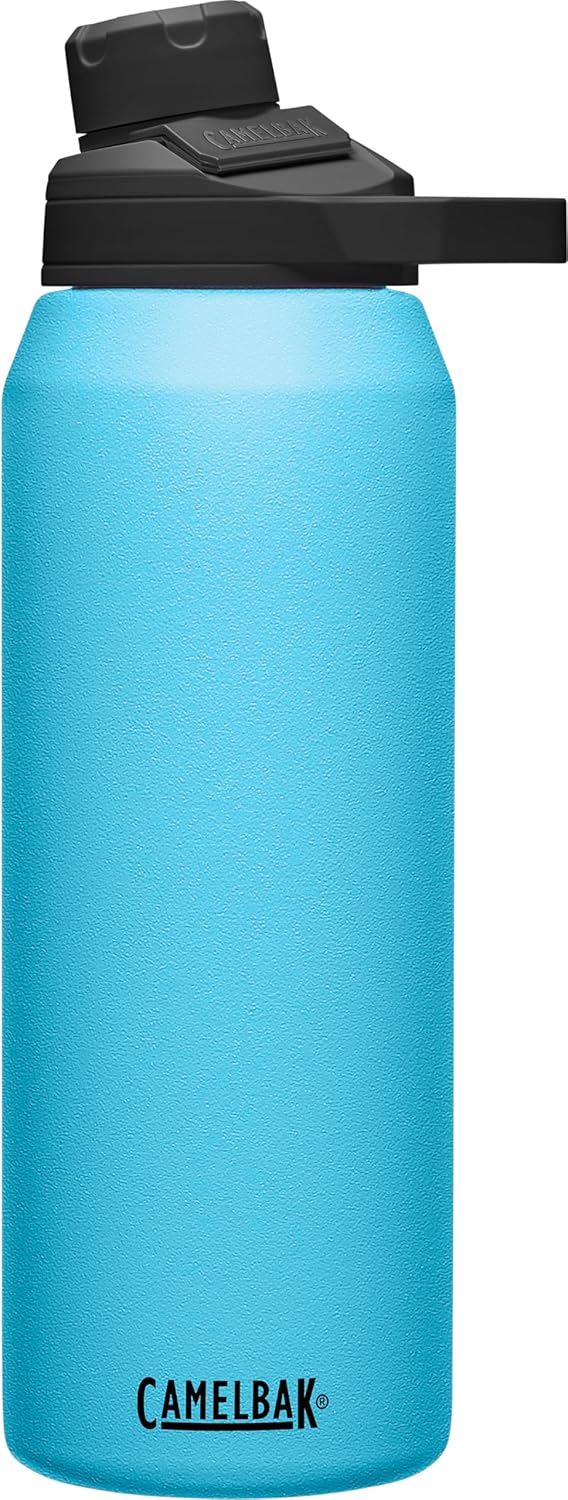
Buy it if you drink while walking, driving or working and you are tired of a cap swinging into your face.
The cap is the whole argument for choosing this over the Takeya. It unscrews, then parks magnetically against the side of the bottle and stays there. The chute pours a controlled stream instead of the gulp you get from a wide mouth, and CamelBak says the exterior resists condensation so it stays dry in a bag. Same price bracket as the Hydro Flask, and the listing carries more than one size.
On sealing: no published CamelBak statement found on how its vacuum port is closed. Ask before buying if that is your deciding factor.
The drawback: you are buying a mechanism. Cap, seal, magnet and tether are four separate parts with seams, where the Klean Kanteen has a threaded cap and nothing else. More parts means more to clean and more that can eventually stop working. Worth it for one-handed drinking, but go in knowing.
See the Chute Mag on AmazonBest cold retention
Hydro Flask 21 oz Standard Mouth with Flex Cap

Buy it if you fill it in the morning and need it still cold at night.
Hydro Flask rates its TempShield insulation at 24 hours cold and 12 hours hot, says the Flex Cap is leakproof when closed, and the 21 oz standard-mouth body slips into a cup holder. It is the most expensive steel pick here, and what the extra buys is a better carry strap, a tougher finish and the name on the side. Not a step change in performance.
On sealing: Hydro Flask said in February 2024 that it has not used lead in its sealing process for over a decade. Not sure you need insulation at all? See insulated vs non-insulated water bottles.
The drawback: a standard mouth is narrower than the wide-mouth version of the same bottle, and that narrowness is what buys the cup-holder fit. Ice cubes and bottle brushes are what you give up. If you ever put anything but water in it, that matters more than the insulation does.
Check the Hydro Flask 21 ozThe one everyone is asking about
Stanley IceFlow Flip Straw 2.0, 24 oz

Buy it if a straw makes you drink more, and you have read the lead section and are satisfied.
We included this deliberately. Leaving it out would be dodging the question the page exists to answer. It is insulated steel with a flip-up straw and a carry handle, and Stanley states the spun-steel body runs about a third lighter than standard stainless. Price lands near the Takeya.
On sealing: this is the one brand that has answered in public. Its maker says the base pellet contains lead, that a stainless layer covers it, and that no lead touches the drink or the drinker. A federal judge dismissed the consumer case twice, most recently in April 2026, finding no plausible route of exposure. Satisfied? Buy it. Not satisfied? The honest next step is not a different insulated brand chosen at random. It is the single-wall bottle at the top of this page, or a brand that publishes a lead-free seal.
The drawback: that lid is the most complex assembly on this page. Stanley’s own description lists a twist-on lid, a flip-up straw, a removable spout and a replaceable seal. Four surfaces to clean, and parts are sold as replaceable because parts like these get replaced. A straw lid is also the wrong lid for anything hot.
See the IceFlow on AmazonAll six compared
| Bottle | Insulated | Lid | Cup holder | Sealing statement |
|---|---|---|---|---|
|
Klean Kanteen Classic 18/8, unlined |
No | Screw loop | Slim sizes fit | Not applicable |
|
Takeya Actives 24 oz 18/8 steel |
Yes | Spout | Yes | None found |
|
Lifefactory 22 oz Glass + sleeve |
No | Chug cap | Tight with sleeve | Not applicable |
|
CamelBak Chute Mag Stainless steel |
Yes | Magnetic chute | Smaller sizes | None found |
|
Hydro Flask 21 oz Stainless steel |
Yes | Flex cap | Yes | Lead-free (2024 statement) |
|
Stanley IceFlow 24 oz Stainless steel |
Yes | Flip straw | Yes | Yes, lead pellet under steel |
On a phone, swipe the table sideways to see every column. “None found” means we searched the brand’s public material and its Amazon listing in September 2026 without locating a statement. It is not a finding about what the bottle contains.
Still deciding?
It comes down to one question. If the lead story is what brought you here, take the single wall and accept warm water. If you want cold water all day, take the Takeya and ask the maker about its seal.
The ten-second check before you buy
- Find the grade. 18/8 or 304 belongs in the listing text. If the seller will only say “food-grade”, close the tab.
- Single wall or double wall? The only question on this page that changes what is physically inside the product.
- If double wall, search the brand name with “lead-free”. Some brands answer plainly on their own site. Two minutes settles it.
- Measure your cup holder. Anything above 24 oz is a coin toss, and a bottle that will not fit the car is a bottle you stop carrying.
- Count the lid parts. Every seam, straw and gasket is a small chore you have signed up for, weekly, for years.
Making one last
When someone says their steel bottle tastes metallic, the steel is rarely the culprit. It is usually a lid gasket that has never come out and a bottle that gets capped while still damp. Two habits fix almost all of it. Pull the silicone seal out of the lid once a week and wash both sides. Leave the bottle open and upside down to dry instead of screwing the cap back on. Neither habit has anything to do with the material, and both matter more than which of these six you choose.
Narrow mouths, straws and lid crevices are the hard parts, and a normal sponge will not reach any of them.
If you already own the bottle

The OXO Good Grips set covers all three problems in one: a long brush for the bottle, a thin brush for straws, and a detail cleaner shaped for the crevices in caps and lids. It costs a fraction of any bottle here. If you buy the Stanley or the CamelBak, you need something like this on day one.
See the OXO cleaning setFreshness note. Rules, litigation and listings all move. The EU restriction and the US position described here are current as of the review date below, and the Stanley case was dismissed without prejudice, so that record could still change. Ratings, sizes and availability change without notice, so check the listing before you buy.
Questions people ask
What is the safest water bottle to drink from?
Unlined 18/8 stainless steel or plain glass, with a lid you are willing to take apart and wash. Both are inert against water, neither has an interior coating that can wear through, and neither ever contained a bisphenol.
Are BPA-free water bottles actually safe?
A BPA-free label means the maker left out one specific chemical. In the US it is not a regulated claim, no testing standard sits behind it, and the substitute is often BPS. Worth noting that the EU’s 2024 ban covers other hazardous bisphenols too, not only BPA. Steel and glass sidestep the whole question.
What is the best water bottle material?
For safety, 18/8 steel and glass are level. For daily life it depends on your routine: glass tastes most neutral, single-wall steel is lightest and simplest, and insulated steel is the only one that keeps water cold all day.
Do insulated stainless steel bottles contain lead?
Some do, some do not. The vacuum port in the base has to be sealed, and a lead-containing pellet is one common way. Stanley’s maker has said publicly that it uses one, covered by a stainless layer, and a federal court dismissed the resulting consumer case in April 2026 for lack of any plausible exposure route. Other makers use lead-free solder or glass plugs and say so, Klean Kanteen among them. Single-wall bottles have no port to seal at all.
Are chemical-free water bottles a real thing?
No. Everything is a chemical, water included, and no agency certifies the phrase. Treat it the way you would treat “non-toxic”: a marketing line, not a specification.
Which water bottle fits a cup holder?
Look for a body diameter near 2.9 inches and be sceptical above 24 oz. The Takeya Actives and the 21 oz Hydro Flask are both built for it. Wide-mouth insulated bottles usually are not.
Is a BPA-free stainless steel water bottle different from a plain stainless one?
On the steel itself, no. Stainless never contained BPA, so the label is describing the lid and any plastic parts. Read it as a statement about the cap and ignore it as a statement about the body.
Is BPA banned in the United States?
No. The EU banned it in food-contact plastics, coatings, varnishes, inks and adhesives from 20 January 2025. The FDA withdrew its authorisation for BPA in baby bottles, sippy cups and infant formula packaging, but said this reflected those uses being abandoned and not a safety finding. Its wider position has not changed since 2014.
Written by: Lara Yehia, Cupindy Home & Kitchen Team
Experience note: Eight years writing home and kitchen product guidance for Cupindy, with a focus on materials, food-contact safety claims and the way manufacturers word them.
Last reviewed: September 2026 — Reviewed for: product availability and ratings, BPA regulatory status in the US and EU, the status of the Stanley lead litigation, and which manufacturers publish a vacuum-sealing statement.
Sources reviewed
- Commission Regulation (EU) 2024/3190 of 19 December 2024, on bisphenol A and other bisphenols with a harmonised hazard classification in materials intended to come into contact with food. Applies from 20 January 2025.
- US Food and Drug Administration, Bisphenol A (BPA): Use in Food Contact Application, including its statement that BPA is safe at current levels in foods and its explanation of the baby bottle and sippy cup amendments.
- Environmental Working Group, February 2024, carrying Pacific Market International’s statement on the sealing pellet and EWG’s response that lead-free vacuum sealing alternatives are in use.
- Reporting on the consumer litigation against Pacific Market International, dismissed in January 2025 and again on 3 April 2026 in the US District Court for the Western District of Washington.
- Klean Kanteen’s published statements on lead, including its use of lead-free solder and silica or glass plugs in insulated products.
- Manufacturer listings and specification pages for each product named above, checked September 2026.


